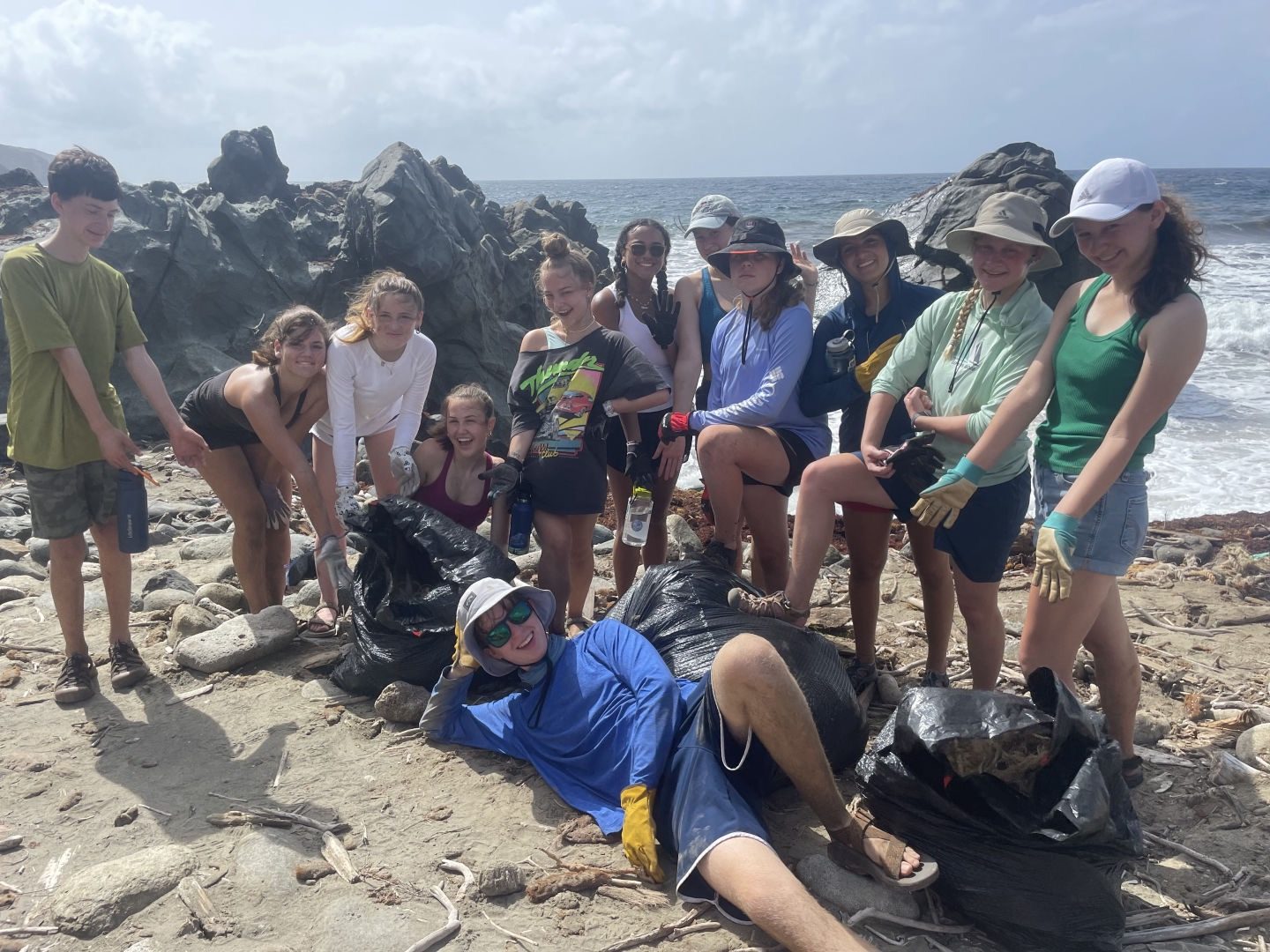
Crew after a coastal cleanup on a rocky British Virgin Islands beach

Environmental Service

British Virgin Islands

Preserving Paradise — one month aboard a 50-foot sailing boat, and the President’s Volunteer Service Award.

For a month, I navigated the waters of the British Virgin Islands while living aboard a 50-foot sailing boat with ten other teenagers from around the world. This immersive service-learning “Preserving Paradise” program combined global citizenship with ecological action, culminating in 100 hours of community-led conservation and service projects. I was honored to receive the President’s Volunteer Service Award (Gold Tier) from President Biden in recognition of my community service and environmental work.

Beyond learning the hands-on responsibilities of running a ship, including cooking, maintenance, and navigation, I trained to earn my certification in sea turtle tagging. Our service efforts targeted three critical areas of island sustainability. First, we partnered with local farmers to build agricultural infrastructure, aiming to increase food security and reduce the islands’ heavy reliance on imported produce. Second, we worked on coastline restoration to repair mangrove ecosystems decimated by recent hurricanes. Finally, we collaborated with marine biologists to track and protect endangered sea turtle populations through field research. Living in such close quarters built a remarkable, tight-knit community that completely transformed my understanding of cross-cultural collaboration.

President’s Volunteer Service Award, Gold, 2023.
Letter from President Biden.

The fishing net

On the fourth day of our voyage, we dropped anchor at Virgin Gorda for a coastal cleanup. Although the beach nearest our boat was picturesque, witnessing the windward side of the island was sobering. The sheer volume of discarded fishing gear, plastic debris, and marine trash completely obscured the sand. Our crew immediately began hauling bags of waste, focusing heavily on microplastics and abandoned fishing nets. Amidst the debris, one massive, extremely embedded fishing net caught my attention. Several peers and mentors told me it was too heavy and deeply buried to remove, but I refused to leave it behind. I began digging out the mass by hand, but I eventually rallied a team of students to help with the excavation. After a grueling group effort, we freed the net from the sand. I helped coordinate the heavy lifting as we carried the massive weight over a steep hill back to our boat. Instead of adding it to a landfill, I repurposed the net on our boat as an outdoor storage container for wet gear and shoes, turning marine pollution into a functional tool for our journey.

The mangrove forest

Mangrove forests are among the most productive and vital ecosystems on Earth. They act as a natural defense against storm surges, protect vulnerable shorelines, provide a nursery for marine life, and serve as highly efficient carbon sinks that actively mitigate climate change. Their unique root anatomy allows them to slow tidal water, which causes sediment to settle to the bottom and trap nutrients. For our final project, we partnered with local conservationists to plant more than 5,000 mangrove seedlings across the archipelago in just five days, helping to restore what had been lost to intense hurricane activity. Outfitted in mud suits, we waded into deep, marshy wetlands to begin planting. Our objective required a delicate balance: maximizing our positive ecological impact while minimizing our footprint on the surrounding habitat. Because mangrove seedlings have low survival rates in the wild, planting at this scale is crucial to ensuring that enough healthy trees mature into a resilient forest barrier, securing the future of the island’s coastal ecosystem. By planting these seedlings, we were rebuilding an essential marine nursery that shelters juvenile reef fish and endangered sea turtles before they venture into the open ocean.