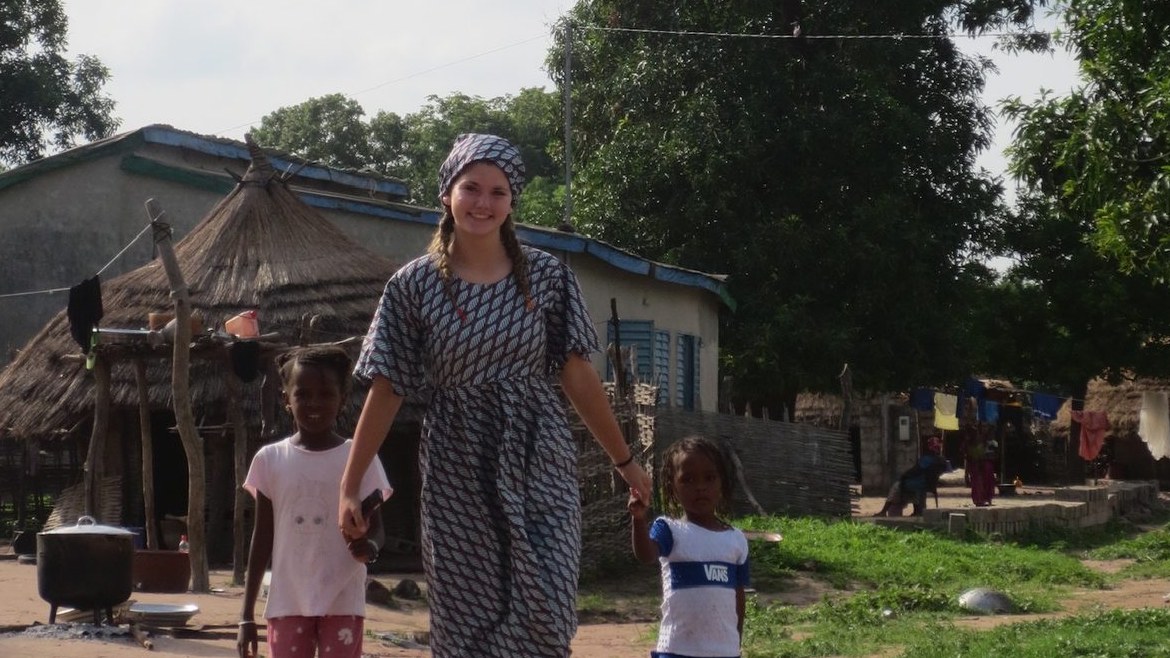
I received special permission to be the youngest participant on an intensive cultural immersion trip to West Africa. That trip exposed me to so much that I will always hold in my heart. From meeting an animist tribe that rarely has contact with the outside world to living with a polygamous family with a host father and two host mothers, I was fortunate to connect with new friends despite our different beliefs. The experience included conversing in basic Wolof and Pulaar, sleeping in full-body mosquito nets, and seeing hyenas in the wild, all while trekking across the Guinea-Bissau border, experiencing day-to-day life without running water and plumbing, and waking up to a flooded room that ruined all my belongings. Despite the headwinds, I am immensely grateful for the joy I experienced, the care I was shown, and the lessons that I will carry forward.
Cultural Immersion
Senegal
The youngest participant on an intensive West African cultural immersion — and a reminder that soccer is a universal language.
The beautiful game
One thing resonated with me above all else in Senegal: the passion for soccer. From dawn till dusk, the sounds of the beautiful game echo throughout the land.
When I first arrived as a toubab (foreigner) in a land with an unfamiliar language and culture, I soon discovered that the children of Senegal were more like me than I had initially thought; our love for soccer united us right away. Every stride, touch, and pass deepened our connection. Our breaths synchronized, sweat mingled, and our moves mirrored each other. What began as a small group of boys in the village of Temento Samba passing the ball back and forth soon grew into a thundering game of full-on soccer. Initially, the village girls watched from the sideline, but by the sixth day, those same girls were ferociously driving the ball into the net. Seeing a female role model whose love for soccer went above any gender barrier created a space where those young girls could pursue their deep love for football.
Leaving that village and traveling to the northern coast, I was uncertain if I would encounter a more accepting view of women’s soccer. My perspective shifted during a visit with a nearby girls’ team. Led by a passionate male coach, this team of over 20 girls, aged 12 to 18, reignited my sense of our shared connection. Each girl’s love for the sport was so evident that it made me forget about the strict gender separation in activities. It was a powerful reminder that passion and dedication can transcend societal boundaries.
Soccer, fútbol, ballon, or football — each culture has its own name for this beloved sport. Yet, beyond the translations, soccer transcends being merely a game.
It is a universal language, a way of life, and a vessel of values that permeates every facet of existence. As soccer remains a fundamental part of countless identities worldwide, I hope that countries like Senegal, which are striving for a brighter future, will prioritize making soccer accessible to all, regardless of gender. In doing so, they will not only foster a love for the game but also champion equality and inclusion for generations to come.